
Priority Mail : Pillars of Creation Forever Stamp 2024
?
Overview:
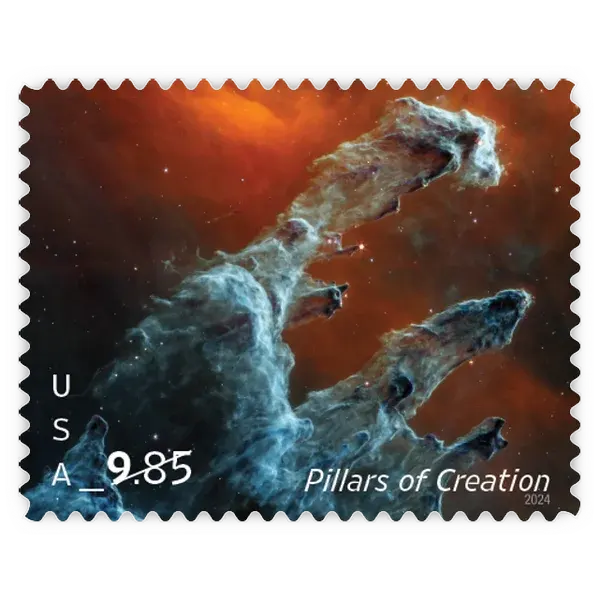
The 2024 Pillars of Creation stamp is a significant addition to the Priority Mail series, featuring a state-of-the-art image from NASA's James Webb Space Telescope (JWST). It is the first non-American Landmarks Series Priority Mail stamp since 2008.
Purpose of Issuance:
This stamp was issued to cover the Priority Mail Rate and to celebrate the groundbreaking imagery provided by the JWST.
Stamp Design:
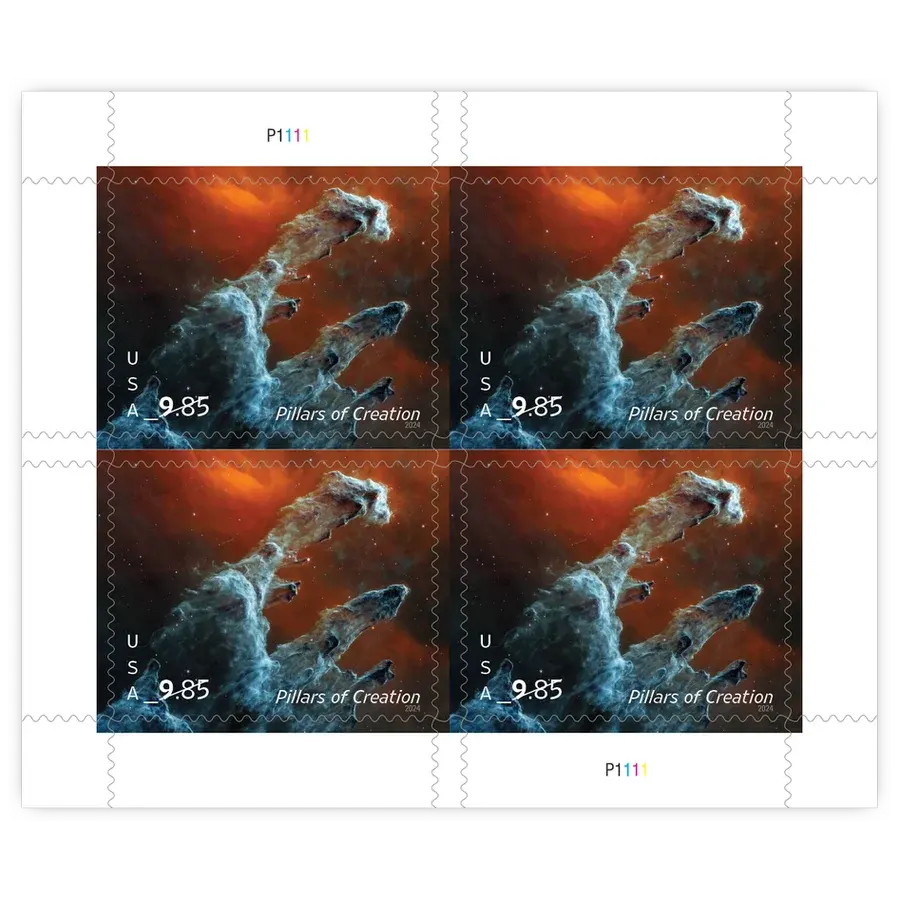
The stamp presents a stunning deep space image captured by the JWST. The USPS describes it as a digitally colored depiction of the mid-infrared light emitted by the Pillars of Creation. The digital colorization assigns hues to various wavelengths, revealing a landscape otherwise invisible to the human eye. Red areas toward the ends of the pillars indicate burgeoning stars ejecting raw materials during their formation, while small red orbs scattered throughout the image represent newly born stars. The creation of this stamp was a collaborative effort with NASA, the European Space Agency, the Canadian Space Agency, and the Space Telescope Science Institute.
First Day of Issue:
Although no formal First Day of Issue Ceremony was held, the postmark for the stamp's release originated from Greenbelt, Maryland, home to NASA's Goddard Space Flight Center, which coordinated the development of the JWST.
Historical Significance:
The 2024 Priority Mail stamp features an image from the James Webb Space Telescope of the "Pillars of Creation," located within the Eagle Nebula. These structures were first photographed by the Hubble Space Telescope in 1995, though they were initially discovered in 1920 by John Charles Duncan using the Mount Wilson Observatory's 60-inch telescope.
Named for their role in star formation, the Pillars of Creation are composed of interstellar gas and dust. The gas and dust in these formations are actively forming new stars, essential for life as they produce heat in the otherwise freezing cold space environment. Over decades of observation, scientists have learned that the entire structure is larger than our solar system.
The JWST, the most advanced space telescope ever launched, has provided even more detailed images, revealing ejections from young stars still forming within the pillars. This enhanced capability promises to uncover even more remarkable deep-space phenomena in the future, continuing the legacy of exploration and discovery initiated by its predecessors.
This stamp not only serves a practical purpose but also inspires awe and curiosity about the vast and dynamic universe we inhabit.