Chien-Shiung Wu Forever Stamp ?C Honoring a Pioneer of Nuclear Physics
The U.S. Postal Service honors renowned physicist Dr. Chien-Shiung Wu (1912?C1997) with a Forever stamp recognizing her extraordinary contributions to modern physics. Widely regarded as one of the leading experimental physicists of the 20th century, Wu built a distinguished career through exceptionally careful experimentation and precise scientific measurement.
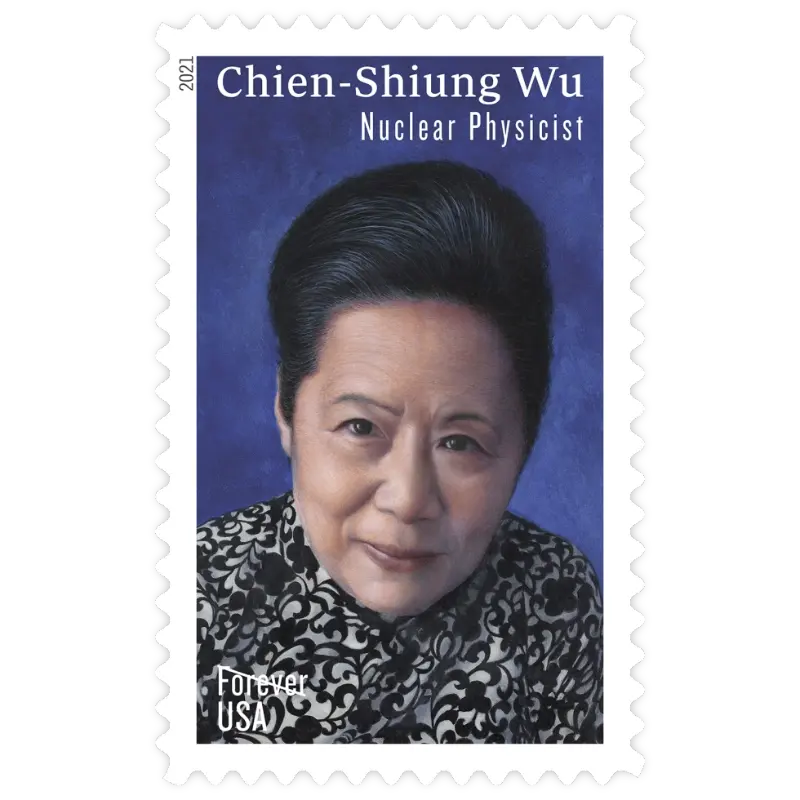
The stamp features an elegant portrait of Wu wearing a traditional Chinese qipao, depicted in a distinctive black-and-white design with a high collar. The original portrait was initially drawn in graphite before being completed with egg tempera. Behind the figure is a rich blue background created with lapis lazuli pigment, a historically prized artistic material that has been used for centuries in paintings associated with religious figures, royalty, and other important subjects.
A Distinguished Scientific Career
Wu spent more than four decades working in physics at a time when scientific research was largely dominated by men. She became particularly respected for her experimental expertise and her ability to design highly accurate tests of important theoretical ideas.
During World War II, Wu joined Columbia University??s Division of War Research in 1944. Her work included research involving uranium enrichment and radiation detection as part of the Manhattan Project. The research was classified, and her experimental work contributed significantly to efforts to understand and control the processes involved in uranium fission.
Following the war, Wu remained at Columbia and continued her research as a professor. Much of her later work concentrated on beta decay, an area of nuclear physics that had presented difficult questions to researchers for many years. By developing improved experimental techniques and a more precise spectrometer, she was able to investigate the phenomenon with a level of accuracy that helped resolve longstanding problems surrounding beta decay.
The Experiment That Changed Physics
One of Wu's most important scientific achievements came in the 1950s. Theoretical physicists Tsung-Dao Lee and Chen-Ning Yang proposed that the long-accepted principle of parity conservation might not apply to weak nuclear interactions. They turned to Wu for experimental assistance in testing their hypothesis.
Wu designed and carried out a sophisticated experiment capable of examining the behavior of particles during weak interactions. Her results demonstrated that parity is not conserved in weak interactions, providing decisive experimental evidence against a principle that had been considered fundamental to physics for decades.
The significance of the discovery was enormous. Lee and Yang subsequently received the Nobel Prize in Physics for their theoretical work, while Wu's experimental achievement became one of the defining accomplishments of her career and an important milestone in the development of modern particle physics.
Stamp Artwork and Issue Details
The stamp was designed by art director Ethel Kessler, featuring original artwork by artist Kam Mak. The combination of the formal portrait, traditional clothing, and deep blue lapis lazuli-inspired background creates a design that connects Wu's Chinese heritage with her remarkable scientific legacy.
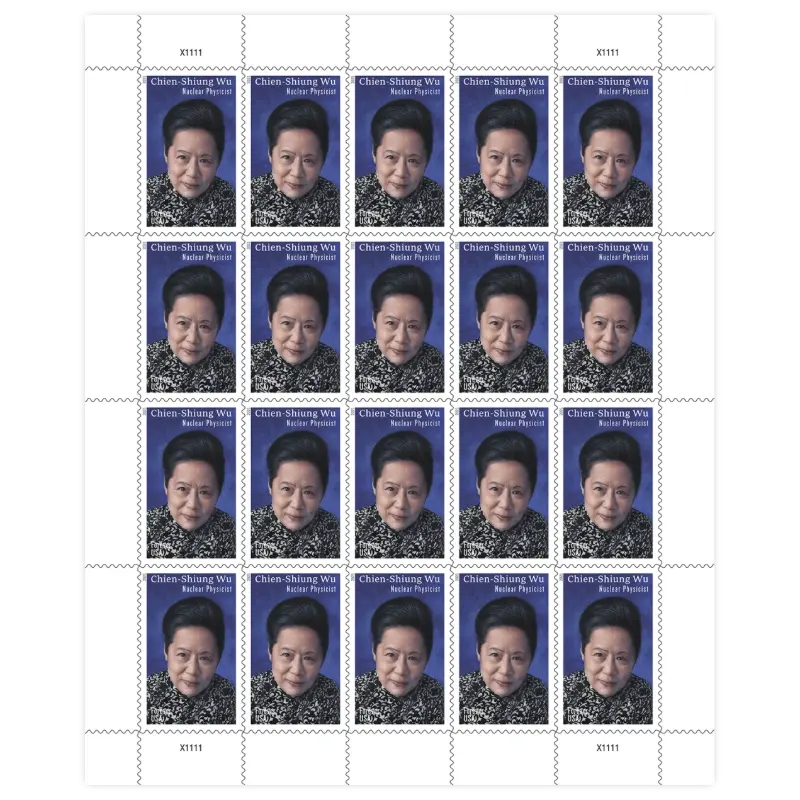
The Chien-Shiung Wu stamp is issued as a Forever stamp in panes of 20. A Forever stamp does not require a new denomination when postal rates change; its value remains equivalent to the current First-Class Mail one-ounce rate.
About the Name ??Chien-Shiung Wu??
The spelling of Wu's name used on the stamp is intentional. It follows the romanized form that Wu herself used when writing and referring to her name and the form by which she was widely recognized within the international scientific community.
This spelling follows the Wade-Giles romanization system, which was once commonly used for Chinese names and words. Wade-Giles has since largely been replaced by Pinyin, which is now the standard romanization system used in both China and the United States.
The stamp therefore serves not only as a tribute to a pioneering scientist, but also as a small piece of postal history commemorating one of the most influential experimental physicists of the modern era.