
Galaxy Pair Forever Stamp 2026
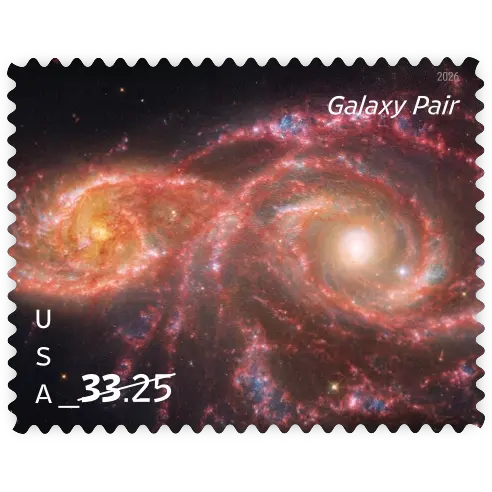
The U.S. Postal Service continues its tradition of celebrating the achievements of astronomy and space exploration with a new Priority Mail Express stamp featuring the breathtaking composite image *Galaxy Pair*, created from observations by both the James Webb Space Telescope (Webb) and the Hubble Space Telescope. The image captures two neighboring galaxies with sweeping spiral structures, brilliant regions of star formation, and vast clouds of dust and gas, revealing the powerful forces that shape the universe over time.
This release expands USPS's ongoing series of space-themed stamps featuring images from the James Webb Space Telescope. Previous issues have highlighted Webb's remarkable views of the *Cosmic Cliffs* and *Pillars of Creation* in 2024, followed by the *Spiral Galaxy* and *Star Cluster* stamps in 2025.
USPS art director Greg Breeding, who has guided the design of earlier Priority Mail and Priority Mail Express stamps featuring Webb imagery, once again directed the creative development of this issue. Reflecting on the selected image, Breeding described it as immediately captivating, noting that its dramatic composition and sense of movement made it a natural choice for a stamp.
The *Galaxy Pair* image showcases two interacting galaxies, IC 2163 and NGC 2207, located roughly 80 million light-years from Earth. These massive celestial neighbors are locked in a slow gravitational interaction, often described as a cosmic dance. Their mutual pull has altered their structures and stimulated intense waves of new star formation across their spiral arms.
The final image combines data collected separately by the Hubble and James Webb Space Telescopes, with each observatory revealing different aspects of the galaxies through its specialized imaging capabilities.
Hubble's observations emphasize the galaxies bright spiral arms, filled with countless stars that appear in shades of blue, while the central regions of the galaxies glow with warmer orange tones. Webb's infrared view reveals a different perspective, highlighting the colder dust that stretches through the galaxies and gives their spiral arms a pale, cloud-like appearance. Regions where young stars remain hidden within dense dust appear pink, while some additional pink areas may represent extremely distant objects located far beyond the galaxies, including active supermassive black holes known as quasars.
By combining the unique abilities of two generations of space telescopes, the image provides a deeper understanding of how galaxies interact, evolve, and create new stars. The stamp brings this extraordinary view of the universe into everyday life, celebrating both the beauty of space and the technology that allows humanity to explore it.
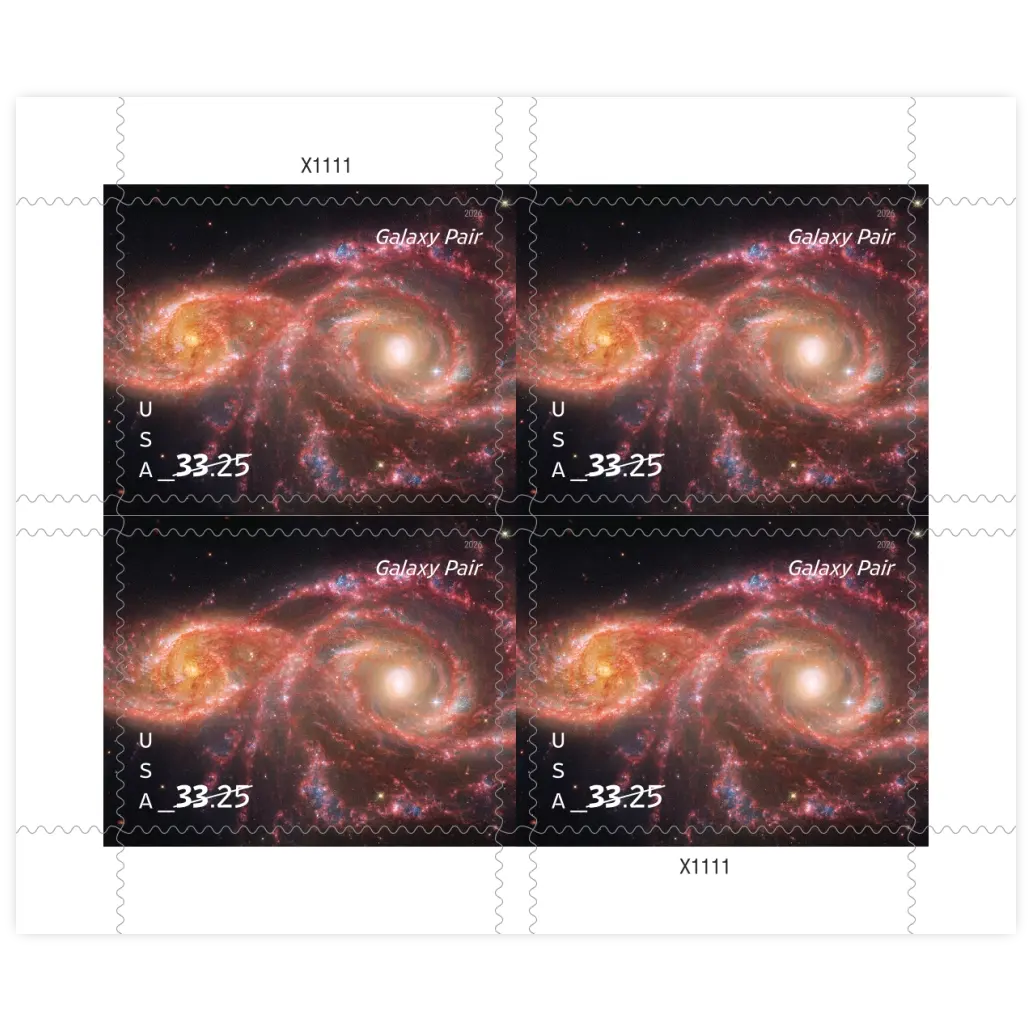
The stamp will be issued in panes of four.
Photo courtesy of NASA.