
Missouri Statehood Forever Stamp 2021
The U.S. Postal Service commemorated Missouri's 200th anniversary of statehood with a special stamp honoring the state's history, landscapes, and cultural heritage. Missouri entered the Union as the 24th state on August 10, 1821, and the bicentennial stamp celebrates the unique character of the Show-Me State.
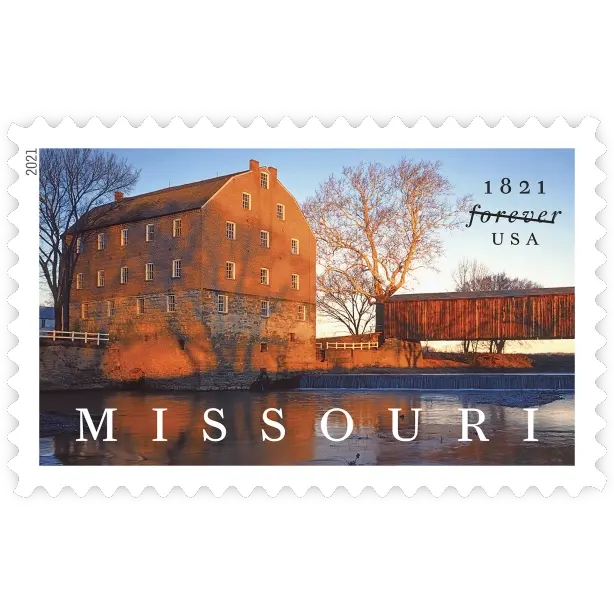
The stamp artwork features a photograph of the Bollinger Mill State Historic Site, showcasing the historic multi-story mill dating from the Civil War era along with the Burfordville Covered Bridge. Built in the 19th century, the bridge is Missouri's oldest covered bridge and one of only a small number remaining in the state, representing an important piece of Missouri's architectural heritage.
Situated near the geographic center of the continental United States, Missouri occupies a significant location in the nation's history and geography. The state shares borders with more states than any other except Tennessee. The Missouri River divides the state, flowing from the northwest toward Kansas City before turning east toward St. Louis, where it meets the Mississippi River, which forms Missouri's entire eastern boundary. Jefferson City, located along the Missouri River near the center of the state, serves as the state capital.
The region has been home to human communities for thousands of years. Early French settlers crossing the Mississippi River in search of furs and mineral resources encountered the Missouria people, whose name was later given to both the river and the state. The first permanent European settlement, Ste. Genevieve, was established along the river in the early 1700s, and St. Louis was founded in 1764. After the Louisiana Purchase in 1803, settlers from eastern states including Virginia, Kentucky, and Tennessee moved westward in large numbers, transforming the region's population and development.
Missouri played a central role in westward exploration and expansion. The state served as the starting point for the Lewis and Clark Expedition, which departed in 1804 to explore the vast territories acquired through the Louisiana Purchase. As the westernmost state when it joined the Union, Missouri became an important supply and gathering point for explorers, traders, and settlers heading farther west.
The state's growth gained international attention during the 1904 Louisiana Purchase Exposition, also known as the St. Louis World's Fair, which highlighted the progress and importance of St. Louis and Missouri. Today, Missouri ranks among the nation's most populous states.
Missouri's natural environment is remarkably diverse. The northern part of the state features rolling hills, grasslands, and prairie landscapes, while much of southern Missouri is dominated by the rugged beauty of the Ozark Mountains, known for its caves, narrow valleys, and abundant springs. The southeastern region lies within the Mississippi River's alluvial plain, where the landscape is lower and flatter.
The state's symbols reflect its rich natural heritage. The white hawthorn blossom is Missouri's state flower, the flowering dogwood is its state tree, and the eastern bluebird represents the state as its official bird.
With dozens of state parks, historic sites, and conservation areas, Missouri offers countless opportunities for outdoor recreation, including hiking, camping, fishing, kayaking, and wildlife exploration. Visitors can discover historic homes, Civil War sites, traditional mills, covered bridges, and scenic natural areas throughout the state.
Missouri also offers a wide range of cultural attractions, from renowned public gardens such as the Missouri Botanical Garden to museums including the Missouri History Museum, National Blues Museum, and Saint Louis Art Museum. Sports fans can follow major professional teams such as the Kansas City Royals, St. Louis Cardinals, St. Louis Blues, and Kansas City Chiefs.
The state is also celebrated for its culinary and musical traditions. Missouri has played an important role in American blues history, with performances continuing in venues throughout the state. Its barbecue traditions especially the distinctive Kansas City and St. Louis styles have earned national recognition.
Missouri's historical landmarks preserve stories from many chapters of American history. Visitors can explore the Harry S. Truman Library and Museum, the Mark Twain Birthplace State Historic Site, the Arabia Steamboat Museum, and the Laura Ingalls Wilder Home and Museum. The state also contains important routes connected to westward expansion, including portions of the Lewis and Clark, Santa Fe, Trail of Tears, Oregon, California, and Pony Express National Historic Trails. Gateway Arch National Park stands as a symbol of America's movement westward and Missouri's role in that expansion.
Missouri's nickname, the Show-Me State,reflects the reputation of its people for valuing practicality, independence, and evidence over empty promises.
The stamp photograph was taken by acclaimed landscape photographer Charles Gurche, whose photography career began in Missouri. Art director Greg Breeding designed the stamp using Gurche's existing photograph.
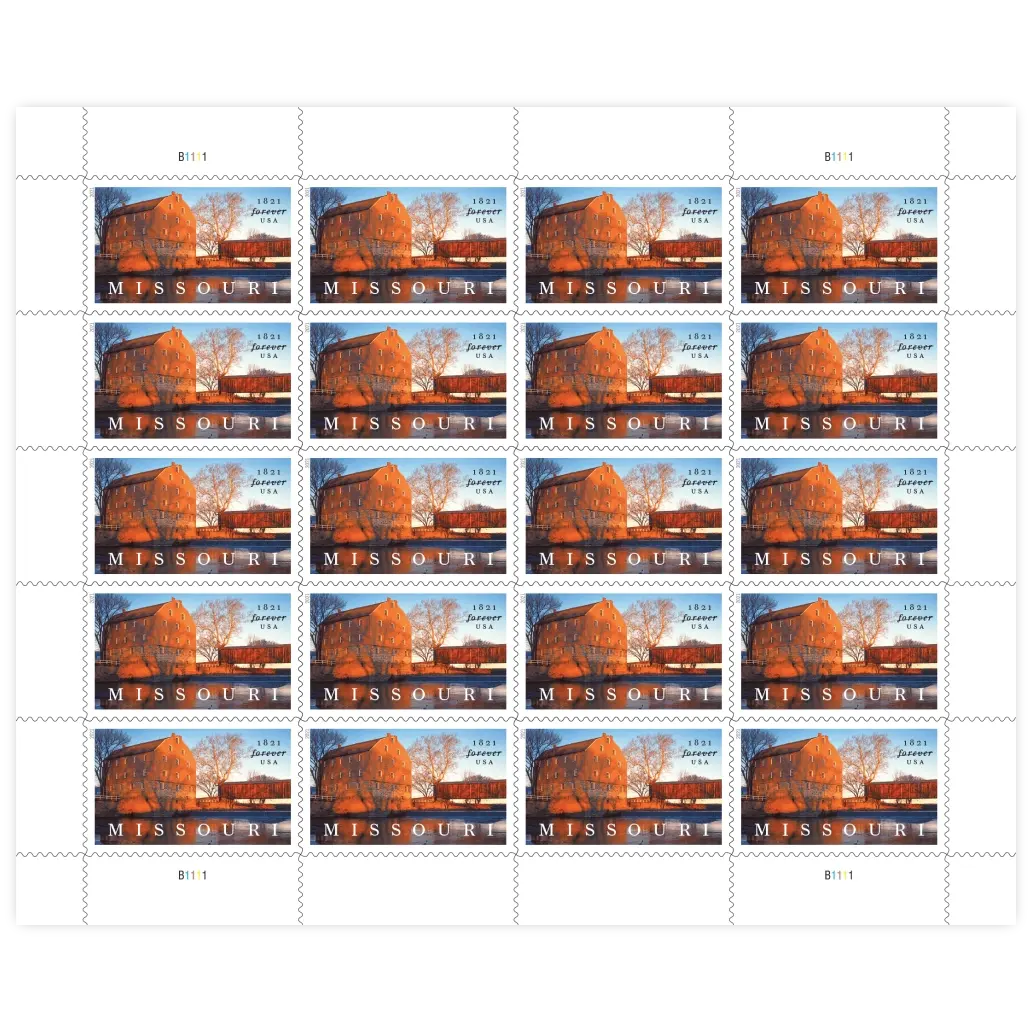
Missouri Statehood was issued as a Forever stamp in panes of 20. This Forever stamp will always retain the same value as the current First-Class Mail one-ounce postage rate.